Book Reflection: The Everything Store
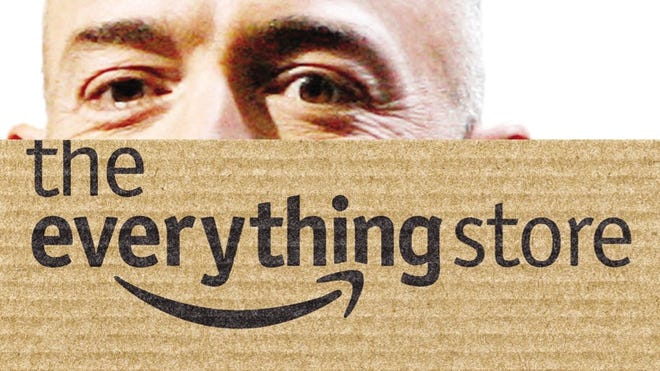
*The book: The Everything Store* by Brad Stone
Just finished Brad Stone’s biography of Amazon and Jeff Bezos. I didn’t know much about Jeff Bezos previously, and wow, I really admire Jeff. He conveys an extraordinary combination of long-term vision and relentless execution, not dissimilar to that of the late Steve Jobs. It’s that combination that brought Amazon to its present-day success.
Maniacal. I caught myself using this word when describing Jeff Bezos to a friend yesterday. This word encompasses a lot: vision, focus, tirelessness, and a little bit of craze. There’s a thin line that separates genius and madness, and success is the final judge.
Vision

Bezos is very smart, something that’s not uncommon among tech visionaries. An engineer by training with an knack for leadership. In 1993, when he worked at the quant hedge fund D.E. Shaw, he noted the unusual growth growth of the World Wide Web, which led him to think “What kind of business plan might make sense in the context of that growth?” That thought eventually led to the founding of Amazon.
Bezos analyzed the variety of businesses which can take advantage of the coming wave, and settled on the idea of an Everything Store. When he was interviewed in 2012, he explained it this way:
I very frequently get the question “What’s gonna change in the next 10 years?” … I almost never get the question “What’s not going to change in the next 10 years?” And I submit to you that that second question is actually the more important of the two. Because you can build a business strategy around the things that are stable in time. (Source)
He saw the future, and believed in it deeply. And chased after it relentlessly.
Unrelenting
Within Amazon, Jeff Bezos is known to have a high bar for performance. In the book, that’s portrayed somewhat negatively — Bezos can be very, very demanding. It seems like everyone worked like the startup founder, and whoever didn’t left the company quickly. At the same time, Bezos led the unrelenting charge. He was a general that led the army at the forefront, and worked harder than anyone else. I bet that’s hugely empowering for employees that also bought into the vision.
Whenever Jeff puts his focus on a problem, known as the “question mark elevation”, the problem is put under an intense spotlight, and it goes resolved. He’s willing to go against the popular opinion and advocate for his belief.
He knew that for Amazon to continually delight customers, oftentimes with lower prices, and for Amazon to be financially successful, operational effectiveness is key. Infamously, Amazon offices are furnished with “door-desks”, desks made of cheap wooden doors, outfitted with wooden pillars as legs. It marks a point for Amazon’s frugality, and is a symbol that indoctrinates any newcomer. This is not a place to coast for the benefits.

Chatting with friends that worked there, I learned that Amazon is notoriously frugal among tech companies in perks. There’s no free lunch. But interestingly, I also don’t believe Amazon is losing the talent war. Rather than using perks and compensation as carrots, Amazon chases after smart, hard-working people with a similar vision. If you are planning to sacrifice the next X years and dedicate them to Amazon, we will also reward you handsomely. Perhaps that’s a better recruiting technique?
In the end, and for better or for worse, Amazon seemed to assemble one of the hardest working team in technology, and one that is not easily deterred by external criticism or challenges. Actually, it’s quite similar to Apple in this sense. And by attracting the best people working their hardest, Amazon is starting to set itself up for success.
Culture
To align everyone, Amazon built a strong and distinctive company culture. Here is a summary look.
It’s no accident the Customer First is number one. It has and will always be the case as long as Bezos is around. While a lot of these are seemingly boilerplate, for example Ownership, Bias for Action, Deliver Results, there are some cultural principles that are decidedly uncommon — even controversial.
“Leaders are right a lot.” Maybe this is true at other companies, but I haven’t seen it advertised as much. Many companies value the democratic voice, but Amazon here is advocating an uncommon voice, almost saying, “do what your manager says; she has more experience and is generally right.”
Another one that Stone also highlights in the book is Have Backbone; Disagree and Commit. Amazon’s senior executive team is known to be a argumentative bunch, and that’s encouraged by design.
“Leaders are obligated to respectfully challenge decisions when they disagree, even when doing so is uncomfortable or exhausting. Leaders have conviction and are tenacious. They do not compromise for the sake of social cohesion.”
This principle by itself tells me a lot about Amazon’s culture. It’s not a place to cruise along. Rather, you are expected to hold your ground, challenge others beyond your comfort zone. The best decisions emerge from debate, and not passive agreements. Sounds great in theory, but difficult in practice.
Its decision making is markedly top-down, less of the democratic style of Google’s 20% projects. Much of the innovation had been direct results of Bezos’ personal vision for the company. A couple examples include: the expansion beyond books into a true everything store; the decision to arbitrarily price Amazon Prime at $79/year. Taken independently, each one seems an arbitrary decision, but if examined under the unifying theme of Amazon’s relentless focus to put customers first, they all start to make sense.
Stone concludes the book by saying:
“When you have fit yourself snugly into Jeff Bezos’s worldview and then evaluated both the successes and failures of Amazon over the past two decades, the future of the company becomes easy to predict. The answer to almost every conceivable question is yes.”
Regret-minimization framework
“When you are in the thick of things, you can get confused by small stuff,” Bezos said a few years later. “I knew when I was eighty that I would never, for example, think about why I walked away from my 1994 Wall Street bonus right in the middle of the year at the worst possible time. That kind of thing just isn’t something you worry about when you’re eighty years old. At the same time, I knew that I might sincerely regret not having participated in this thing called the Internet that I thought was going to be a revolutionizing event. When I thought about it that way… it was incredibly easy to make the decision.
Indeed, it’s something I think about a lot. Looking at the long-term view is liberating and simplifying. Figure out what’s the BIG stuff, and then relentlessly chase after that.
Thanks, Jeff.