Book Reflection: The Hard Thing About Hard Things
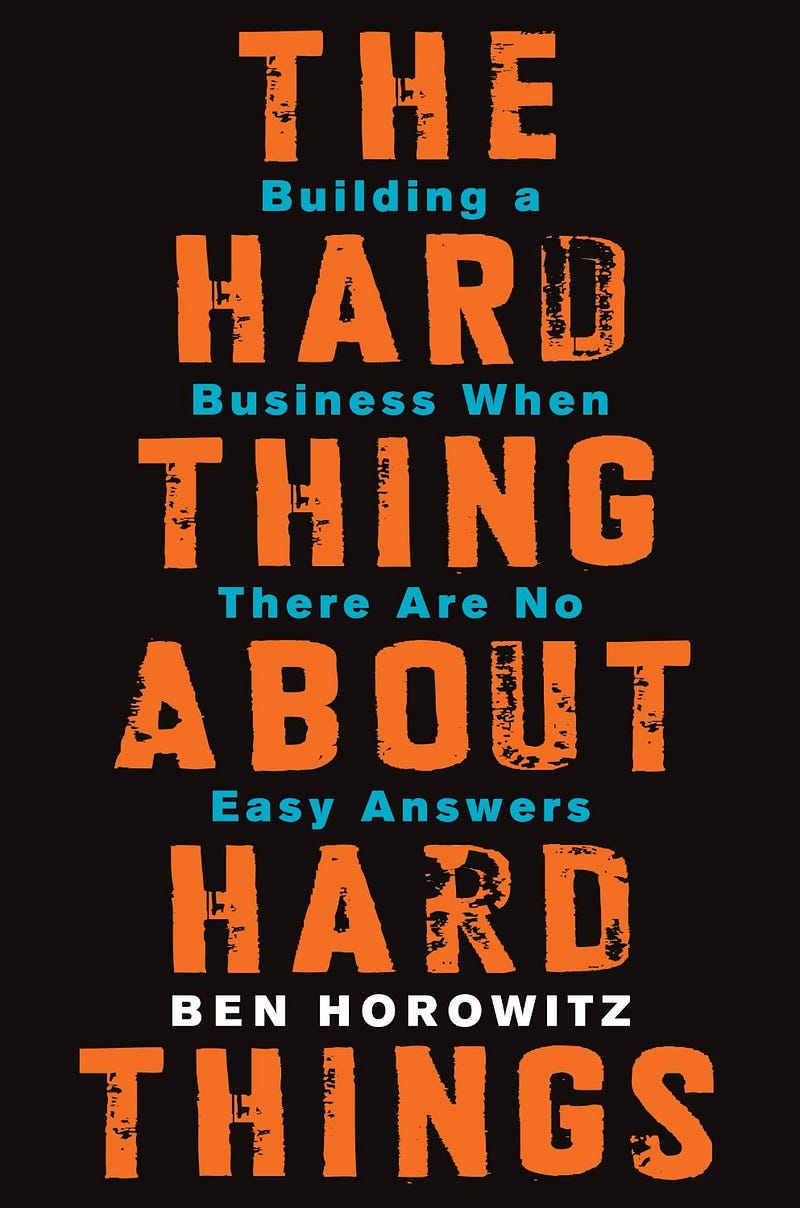
The book: Hard Thing About Hard Things by Ben Horowitz
Wow, I’m enthralled by this book. To me, it’s a management bible — one that is rooted in the blood, sweat, and tears of Ben Horowitz’s personal experience running a company through the dot com bust, and resurrecting it from the bottom. When CEOs talk about their struggles, I listen. I have the upmost respect for people that are “wartime” generals.
It’s damn hard to be a good CEO, and two big parts of that challenge are 1) managing uncertainty, and 2) managing people.
This is a dense book. Although Horowitz structures it as a series of 2–4 page short stories, each one packs in so much meaningful content and ernest advice worth pondering. It’s a book I’ll be keeping around and revisiting when the topics become relevant.
Thinking back, my biggest takeaway is to be transparent and direct. Walk others through the thought process. There will be tons of hard decisions and hard conversations, and the only way through it without losing respect/integrity is to tell it like it is. No sugarcoating. Like the Chinese proverb: “paper can’t hold fire.”
This is one of the most powerful stories I’ve read. I’d recommend every founder/CEO/leader to read the first 3 chapters where Horowitz tells his story of The Struggle. If only as a reminder that darker days loom ahead still, but there is light at the end.
When things fall apart
- Tell it like it is. Don’t shield problems from employees to only portray positivity.
- Develop a culture that rewards people for surfacing problems into the open where they can be solved.
- When laying people off: be clear of your reason; don’t delay; train managers to lay off their own people; address the company; be present.
- It may be necessary to demote a loyal friend. The goal is to be honest, clear, and effective, not to take the sting out of it. Goes also for firing executives.
- There is no silver bullet. Just a lot of lead bullets (hard, hard work).
- Nobody cares (about excuses). Spend zero time on what you could have done, and devote all your time on what you might do.
Take care of the people, the products, and the profits — in that order
- Hire executives based on their strengths, and work with them on the weaknesses. You won’t find a rockstar for your startup just yet; if they truly are, they’d be the CEO of IBM.
- Make your company a good place to work. When things fall apart (and monetary/career incentives disintegrate), that’ll be the only thing holding people together.
- Training is important. Deliver management training yourself, and require functional training of new employees. It’s one of the highest leverage activities possible.
- Transparency trumps. When hiring people away from your friend’s company, be clear that you will have to ask for reference.
- When hiring people with big company experience, screen for match with your needs and take integration seriously.
- Know what you want when hiring for a job. Hire someone that is world-class and operationally outstanding. Interview for objective excellence and fit.
- Beware of management debt similar to technical debt, decisions that benefit the short term but with a high interest rate. It’s often not worth it.
- A good HR cannot build you a well-managed company, but it sure can tell you when it’s not.
Concerning the going concern
- Apolitical leaders may inadvertently create politics by not being careful around sensitive topics, such as performance, comp, org design, and promotions. Hire people with the right ambition, have structures, and be clear, fast to act.
- The right kind of ambition: ambition for the company’s success with the employee’s own success only coming as a by-product of the company’s victory. This can be screened for people with a “team” prism vs. a “me” prism, and is obvious.
- On promos and titles, ensure there is a consistent leveling process across orgs.
- Be careful with intelligent but bad employees. You may need to keep them, but you can only hold the bus for one person.
- “Hiring senior people into a startup is kind of like an athlete taking performance-enhancing drugs.” Set a clear and high standard for senior people.
- 1:1 is the employee’s meeting rather than the manager’s meeting.
- On creating culture: shock value ▸ conversation ▸ behavior change. Small easy-to-implement things that have lasting impact.
- The right way to pick mentors, employees is to learn the basics, and make decisions based on the right context.
- 3 things get harder as company scales: communication, common knowledge, decision making. Prioritize org design along those spectrums, and figure out what’s most important. There will be sacrifices. Process should be scaled to meet the needs of the communication it facilitates.
- “Evaluating people against the future needs of the company based on a theoretical view of how they will perform is counterproductive.” Judging people in advance will retard their development.
How to lead even when you don’t know where you are going
- Most difficult CEO skill: managing one’s own psychology. Focus on the road, write things down, talk to friends. Great CEOs don’t quit.
- Courage is hard to muster. It also helps to see a situation more clearly without being influenced by the crowd. It brings objectivity.
- Leadership, defined as 1) ability to articulate vision + 2) right kind of ambition + 3) ability to achieve vision.
- “The enemy of competence is sometimes competence.”
- Peacetime and wartime call for very different CEO tactics. Beware most management books are written for peace, when creativity and discovery are encouraged. In war, exact execution is a must.
- CEO is made, not born. The process can feel unnatural.
- Feedback: don’t give me the shit sandwich. Be authentic, come from the right place (I want you to succeed), not personal, private, fit the recipient’s personality, and be direct, not mean. Have high frequency and build a culture of it.
There are no rules to entrepreneurship
- There is no one-size-fit-all decision to accountability vs. creativity. It’s contextual whether you should hold someone accountable to slips vs. praising for creativity. Think carefully.
- “Freaky Friday” management: switch the heads of departments to solve conflict.
- CEOs don’t have time to develop and grow executives, as it happens elsewhere in the company. Executives need to come ready to perform.
- “You are doing a great job at your current job, but the plan says we will have twice as many employees next year as we have now. Therefore, you will have a new and very different job and I will have to evaluate you on the basis of that job. If it makes you feel better, that rule goes for everyone on the team, including me.”
- Your loyalty must go to your employees. You owe them a world class management team. That’s the priority.
- If 1) early in a very large market + 2) good chance of being number one, doesn’t make sense to sell the company. No one can give you that much forward credit.
Footnote
I found it interesting that the two top reviews on Amazon were strong critiques of the book that misses the point. It immediately makes me think about the quote from Daring Greatly, “don’t mind the critic; it’s those in the arena that counts.”