Crowd sourced information is changing the landscape of cities

Example of crowd-sourced information (I’ll shorten to CSI*):*
- Review sites such as Yelp, Google, Foursquare.
- Background sourced data such as Google traffic.
- (Partially) curated content on individual blogs.
Of course, I’ve been using crowd-sourced information for a long time, without paying much attention to it. My daily routine involves religiously using Yelp to check for reviews, and Google Maps for traffic. It feels second nature, and I’ve never given much thought to it.
Having moved to London a week ago, I’ve come to realize the power of CSI, and how it genuinely changes my approach exploring a new city.
In days past, being transplanted into a new city presents quite a challenge. Where can I go for food? Where do I buy groceries? What are interesting places to explore? There are a few ways, but each presented its own limitations:
- Word of mouth recommendations (preferred): where a concierge, a friend, or another local would give his or her recommendations. However, you are biased by a single person’s opinion. If you’re quite the beer connoisseur, how do you know the concierge is recommending the best craft beer shop and not some random pub?
- Wandering around: literally, walking around the city and trying out different places. This is quite an idyllic approach, but you are limited by time and geography. It takes quite a long time to traverse a neighborhood, let alone trying out different shops.
- Reading the “Yellow Pages”: I mean YP in a figurative way here, standing for any static, and oftentimes paper-based, guides: Lonely Planet, local newspaper, tourist brochures. The challenge here is that you cannot disambiguate genuine review from advertisement, oftentimes being misled to mediocre experience at exorbitant prices.
Crowd sourced information changes all this.
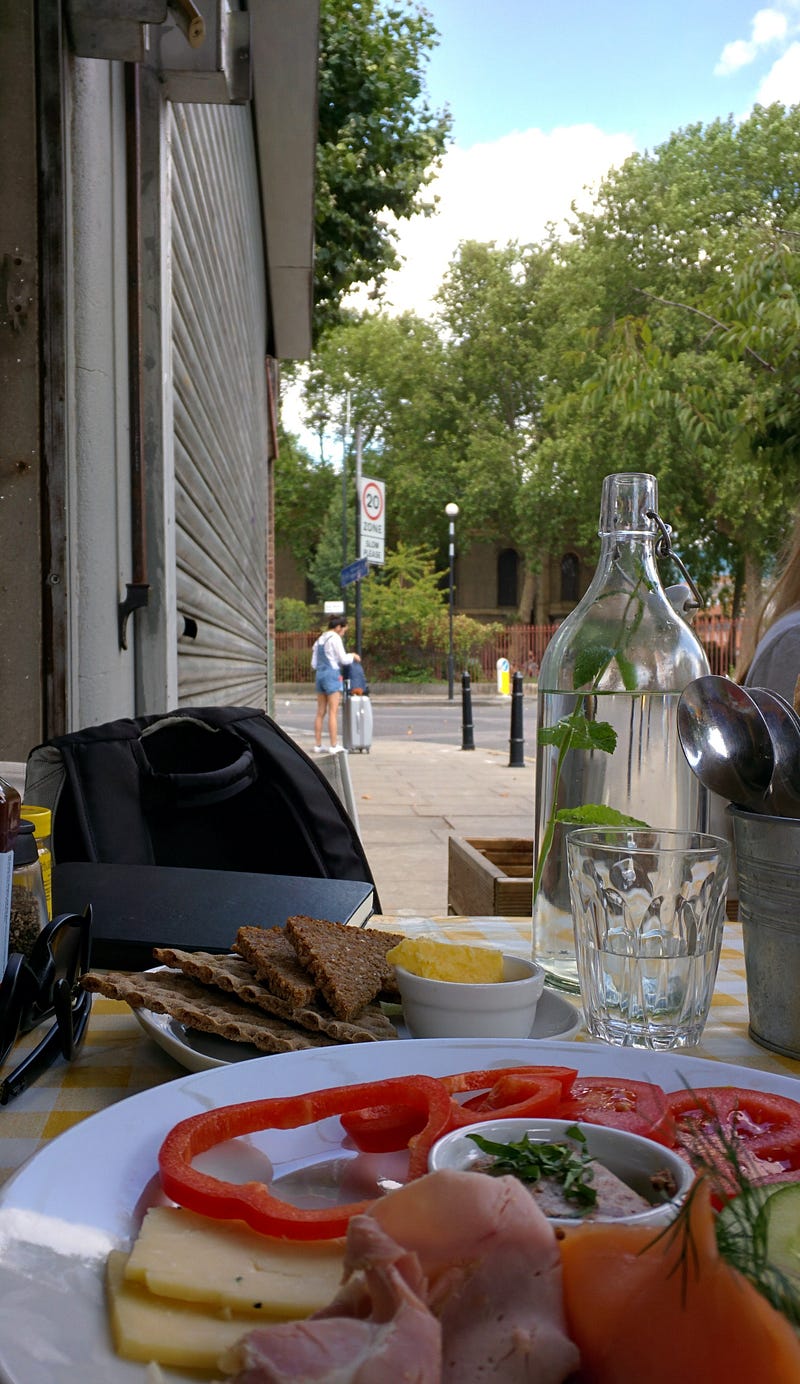
It occurred to me as I’m sitting in the quaint little London cafe (pictured above) this morning having breakfast: I would never have found this place using any of the three traditional methods mentioned above.
The only reason I discovered this spot, which I really do love, is by cross referencing Yelp reviews with Google. I searched for Breakfast nearby me, ran through a few reviews — paying attention to both pictures, “star” ratings, and written reviews — and settled on this place. It has a novel factor (Scandinavian food, what is that?) and trustworthiness (4.5 star average based on 49 reviews).
It occurred to me as I’m sitting in the photographed London cafe above having brunch, that CSI is not anything new. It is merely extending on the word of mouth. What Yelp did here are two things.
- It presented a lot of information in an easily digestible list view, making navigation much easier. Indeed, Yelp information is rich, filled with images, description, everything you’d need to make your own judgement about a place.
- It lends trustworthiness through the crowd. Whereas there was significant variation from person to person, a statistical rating system (~50 people rated a place highly) normalizes the data. Suddenly, I know to expect a level of consistency and quality.
See, this is exactly what word of mouth recommendation presents as well, curating a “short list” of recommendations and lending it trustworthiness. CSI does it at scale.

I know many people that would still prefer word of mouth recommendations over online reviews. In some cases, I do as well. A good friend that knows my taste, that is a huge foodie having tried many restaurants, will surely be able to pinpoint a better place. The personalization is powerful.
Personalization may will be the next big opportunity these apps can tackle, yet it’s quite challenging. While it’ll be a while before machines can algorithmically infer our taste, that day isn’t too far away. Nevertheless, CSI is tremendously powerful today.
If you aren’t already a believer, I implore you — give it a try. Spin up Yelp, Foursquare, Tripadvisor, Dianping, or whatever your local app is. Check out what other people have to say about your neighborhood. You may be surprised.