Value, first and foremost
Two recent stories highlighted the importance of values in a company. The first was a reflection by Chen Nian, CEO of a Chinese e-commerce company VANCL, with $3B valuation at its peak. [link — article in Chinese] The second was a Fast Company interview with Tim Cook of Apple. [link]
Looking through the lens of these two CEOs, I recognized the similarities between companies and individuals. Like each of us at the core, a company is built on values. It becomes the culture, guides decision making, and defines the products built.
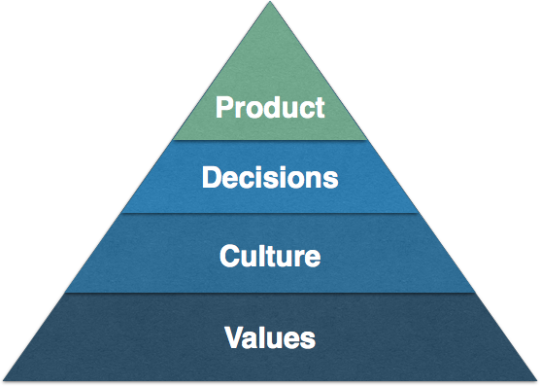
A company’s values permeate through every user interface and customer interaction. It’s intangible but ubiquitous. Setting a clear value is first and foremost to building a long-standing business.
Getting this wrong, on the other hand, only leads to trouble.
STORIES AND EAST AND WEST — APPLE
Steve Jobs changed the world. Famously, he said,
“The ones who are crazy enough to think that they can change the world, are the ones who do.”
Apple is a wildly successful company, and one built on Steve’s vision and values at the core. It’s with this vision that Steve recruited a world-class team of engineers, designers, and marketers. Just look at John Sculley. The company could not have been successful if, as an organization, it didn’t fully subscribe to Steve’s vision to change the world.
When Tim Cook reflects on Steve Jobs’ legacy on Apple, he said:
“Steve was almost viewed from the exterior as the micromanager checking to make sure that every i was dotted, and every t was crossed, that every circuit was correct, that every color was exactly right. And yes, he made a lot of decisions. His capacity was unbelievable. But he was just one person — and he knew that.
It was his selection of people that helped propel the culture. You hear these stories of him walking down a hallway and going crazy over something he sees, and yeah, those things happened. But extending that story to imagine that he did everything at Apple is selling him way short. What he did more than anything was build a culture and pick a great team, that would then pick another great team, that would then pick another team, and so on.
He’s not given credit as a teacher. But he’s the best teacher I ever had by far. There was nothing traditional about him as a teacher. But he was the best. He was the absolute best.
Steve’s greatest contribution and gift is the company and its culture.”
To a bystander, Apple is an innovation company that builds best-in-class tech products and services. A discerning observer will quickly understand that it takes a group (90k+ in 2014!) of people to make all this happen. Even with Steve’s gravitas, Apple’s values to “change the world” needs to permeate to every single employee. So employees can ask themselves the question, “is this decision going to help change the world?”
As Tim said, that is Steve’s greatest legacy. The value became part of Apple’s culture, and permeated through the leader, to the leadership, and to every single decision maker.
STORIES AND EAST AND WEST — VANCL
A counter-example to Apple took place at VANCL in China, amidst its meteoric rise. It’s an Internet fashion apparel brand, manufacturing and selling its own lines of men’s and women’s fashion.
VANCL was China’s Internet darling at the height of its growth. Its ads are plastered all over the streets, with over 5,000 employees and countless SKUs. Many are blinded by the gold-rush mentality of growth, even including its CEO, Chen Nian.
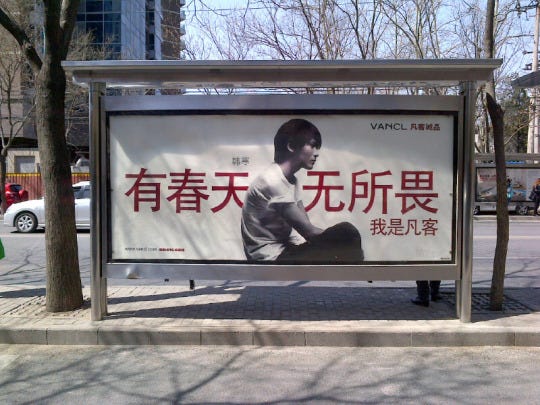
It’s only when Chen had a conversation with Lei Jun of Xiaomi — China’s version of Apple — that Chen started to recognize the holes in his business. At the height of VANCL’s growth, Chen was wearing Prada and Zegna, thinking little about the quality of his own products. He recounts:
当我跟雷军在几百个衣架间走过时,我感到狼狈,因为这也是我第一次看到这么多真实的产品。我挫败地发现,没有一件是拿得出手的。雷军说,他感觉不是站在一个品牌店,而是百货市场。
When Lei Jun (of Xiaomi) and I walked through hundreds of racks of clothing, I felt embarrassed. This is the first time I’ve seen all my products physically, and I realized there’s nothing I’m proud to wear. Jun said, “I don’t feel like I’m in a brand flagship store; I felt like I’m in a supermarket.”
Chen realized that building a quality product needs to be at the core of his company. He decided to roll-up his sleeves and dedicate his attention to creating the most basic of products — a white button-up shirt.
Only when he personally got involved in the company’s most basic decisions, he recognized that VANCL’s culture is being poisoned. Lacking a clear culture of quality, the toxic gold-rush mentality took its place as the value-du-jour. Employees were dismissing quality while chasing vanity growth metrics.
过去一整年,我四分之三的时间都不在北京。为了做好一件白衬衫,我开始密集安排出差,去见供应商,去找工厂。而当我见到供应商时,我才了解到以往我犯的错误有多大,他们告诉我,过去他们到北京拜访过我,但我太”拽”,忙着看PPT,没空见他们。他们只能跟凡客基层的员工打交道,为了拿到订单,还要招待他们洗澡唱歌。
这些事听得我毛骨悚然。可想而知,之前凡客已经挤满了多少凑热闹的人。如何让这些人尽快离场?我出了一个狠招,不再维持凡客的虚假繁荣,把总部从位于西二环的雍贵中心高档写字楼搬到了遥远的南五环亦庄去,谁适应不了随时走人。
大多数人迅速感到了搬家的落差和心理冲击。搬家前,凡客有5000多人,搬家后,我以为减到一千多人就不错了,没想到最后减到了300多人。
In the last year, I spend less than a quarter of my time in Beijing. To make a good white shirt, I traveled all over to meet suppliers and see factories. Only when I met the suppliers, I realized how big my mistakes were in the past. They told me, when they visited me in Beijing, I was too arrogant, always looking at slides and never made time. They could only talk with lower level employees. To get orders, the suppliers had to treat VANCL employees to karaoke and spa.
That frightened me — how my company is filled with vain people only here for the fun of it. How do I get rid of them? I decided to move the headquarter from [editor: the most central part of Beijing] with luxury office buildings to [editor: somewhere very far, requiring long commutes], letting go of whoever want to leave.
A majority immediately felt the shock and disappointment. Before the move, we had over 5,000 employees. I thought it’d be good to have 1,000 people remain, but we only ended up with 300.
A headcount reduction from 5,000 to 300! Since then, VANCL and Chen decided to rebuild from the foundation, with a renewed dedication to quality products as its value. The growth may be slower and less dramatic, but more grounded. Nowadays, Chen proudly sports a VANCL shirt wherever he goes.
LOOKING BEYOND
How come many well-respected companies have limited product lines?
I don’t think it’s a lack of resources. I think it stems from a discipline to follow the company’s core value — sure, Apple can build a TV or dishwasher as good as any other, but it won’t, unless it can create innovation that changes the world.
For what it’s worth, I find this to be true for food products in Japan as well. Many regional specialties are only sold within the region, strictly no export. For example, the famous (and delicious!) Shiroi Koibito cookies are from Hokkaido, and you won’t find it anywhere else in Japan, with the exception of airport duty free. You can’t find it in the fanciest shopping malls in Ginza.
I’m fascinated by the mission statement of companies. Not all companies will live by that mission, but a company that doesn’t pay much attention to it ires me.